Skip

Contactor – exhibitors, products, contacts

International search engine for Technology for Meat and Alternative Proteins
Status: Exhibitors of IFFA 2025

Fava Giorgio Axel s.r.l.

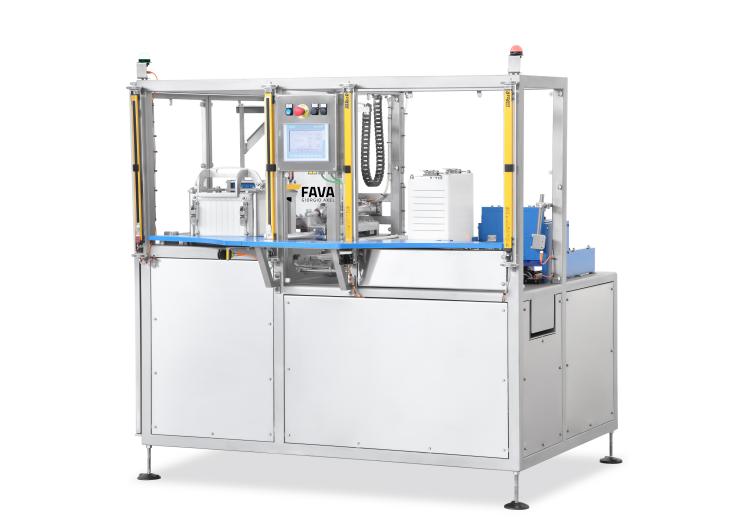
AUTOMATIC SKEWERING MACHINES

Trade fair innovation

AUTOMATIC SKEWERING MACHINES

Fava Giorgio Axel s.r.l.

Description

We produce two different types of automatic skewering machines.

The SPDCSA is an extremely compact machine that, in the first station, performs the insertion of the sticks into the product already placed in the composition molds. Thanks to the special construction solution, the sticks closely follow the pre-drilling needles, thus inserting themselves into the newly made holes in the product in which they are perfectly guided, even in the case of arrosticini (small kebabs). The same machine has, alongside the first one, a cutting station, which is effective, precise and safe. Our skewering machine is capable of handling products of different sections and different lengths, and the ergonomics of loading and unloading increase its real production capacity. The SPCSA is offered in versions for arrosticini only (15, 16 and 20 mm per side, length 100 mm), for skewers only (20, 25, 28 and 32 mm per side, length 160 mm), or universal.
All versions can be equipped with a pneumatic device for extracting the products from the mold, also using a convenient stainless steel band for total extraction of the skewers, or arrosticini, from the mold base plate.The productivity of the machine depends on the number of sticks to be inserted and the cutting length; thus, it is possible to reach the real productivity of 22 to 24 molds/hour in the case of small kebabs having dimensions 15 x 15 mm (till 5,400 /h), while it is possible to produce up to 38 to 40 molds/hour in the case of 28 x 28 mm skewers (till 2,560 /h).

SPDE model skewering machine use straight, circular-section skewers with a single tip, which are loaded without stopping the machine. It is possible to produce skewers with a protruding tip or a tip inside the product. Length and diameter of the skewers are customizable, as are the dimensions of the molds, which can hold 2, 3 or 4 skewers. Productivity ranges from 3,600 to 7,200 skewers/h. The molds are easily removable for washing operations and for replacement with different molds.The machine’s design makes sanitizing activities easy and effective, reducing washing times and still operating in total safety. The modular structure of the SPDE skewer machine allows implementation as production needs change, even in machines that are already in operation; thus, it is possible to have loading areas 1.5 – 3 – 4.5 and 6 meters long, while still maintaining the precision of positioning the molds in the stick insertion station thanks to the brushless motorization.
More products by Fava Giorgio Axel s.r.l.

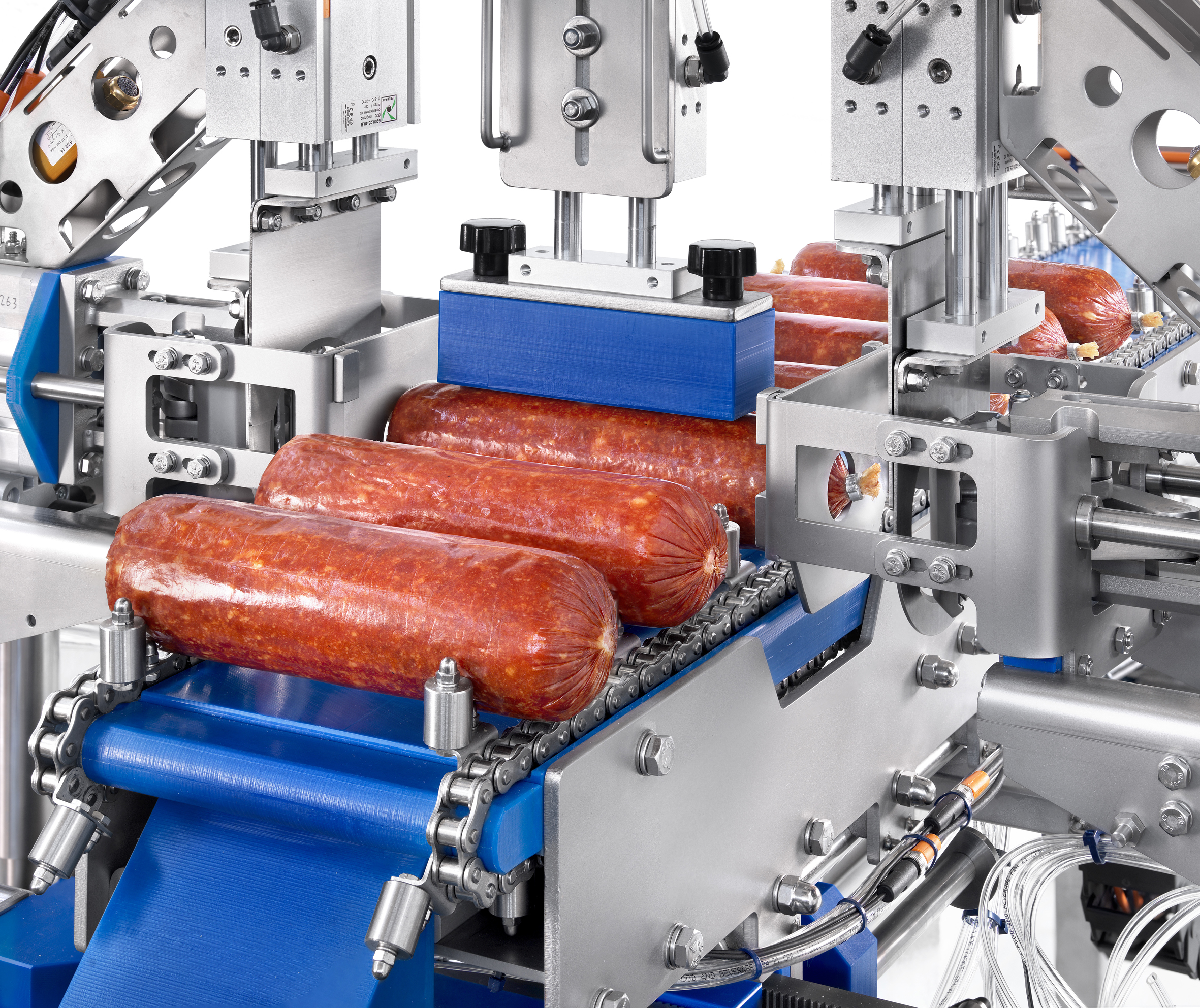
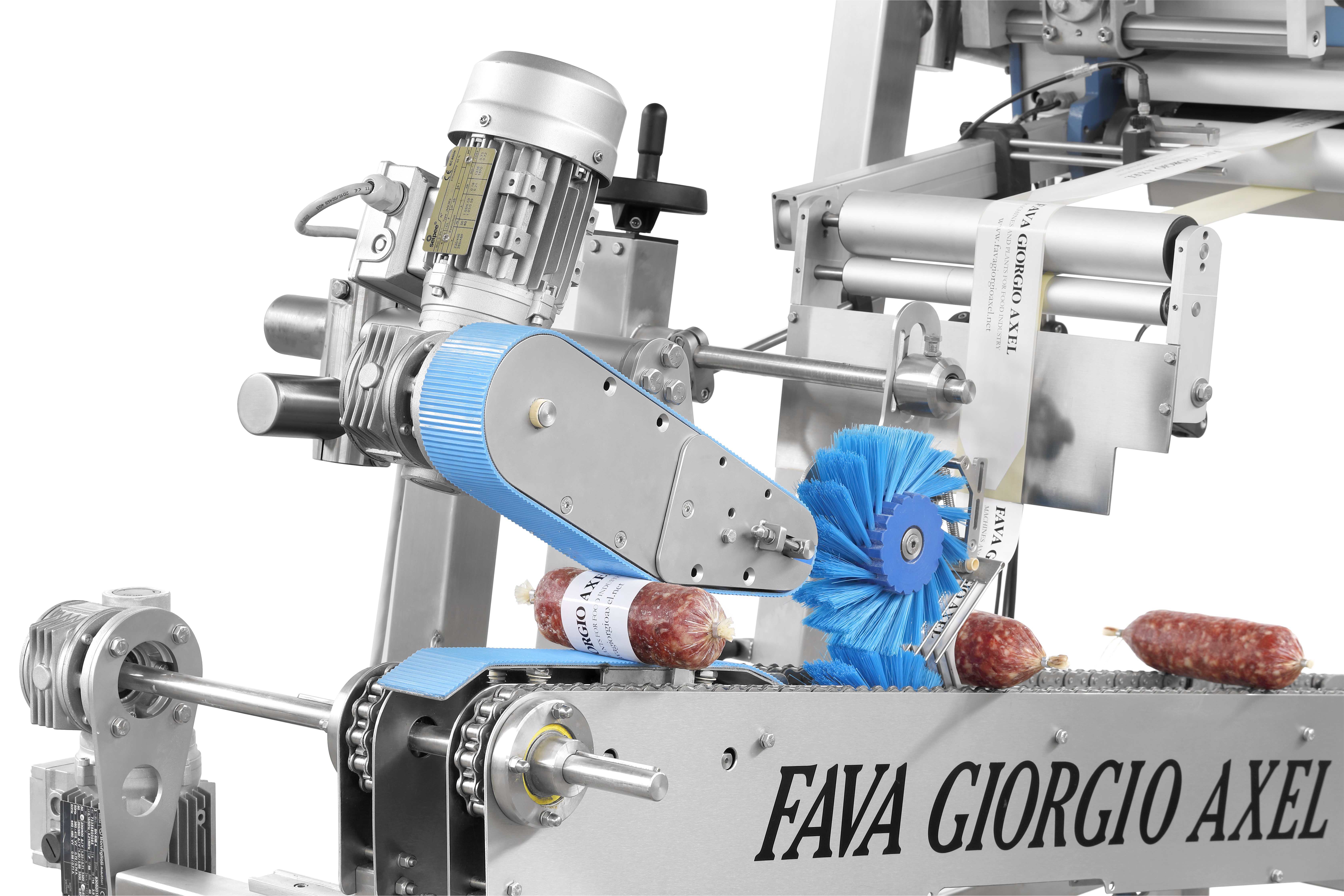
LABELLING MACHINE ETIFLEX

Automatic labelling machine for salamis Etiflex, pneumatic working and control, made of stainless steel and of plastic material for food contact.

The machine structure permits the operator to properly and easily position the product, while the un-loading can be done directly on a transferring belt to the downstream working areas or it can be done by an operator.

The machine is able to use adhesive, or partially adhesive, labels from 30 mm to 280 mm wide, depending on the model. With simple adjustments it performs the labeling of products with a diameter between 30 and 110 mm, and from 150 mm to 600 mm long. The productivity can reach 2.400 pieces per hour depending on the products’ diameter, consequently on the labels’ dimensions and on the operator loading speed. It is also possible to label flat products and U shape products.

The Etiflex labelling machine can be equipped with pigment transfer or ink-jet markers, and can print in plain text and in barcode, data such as production date, batch number, or whatever else is needed.

The label design and precision of the machine allow printing in a defined area, avoiding covering the company brand or other information.

The marker can also print data such as product name and ingredients, in the language of the destination country, eliminating the label changeover time and greatly reducing the label stock.

Our proposal also includes the Etiflex-W model, which can carry out the weighing of each single product, printing the weight, but also the price, in clear and with barcode, in a predefined area, without the need to add labels, without overlapping. The weighing system is certified.All Etiflex labelling machines can be equipped with a device for remote internet connection, both for technical assistance and for modifying the operating modes. Parameters can be stored in recipes, with indications from the operator panel that guide manual adjustment of parts such as the position of the labeling head, gate, brushes and winding belt.

It is possible to insert the machines in the production process for batch management and product traceability.

The touch screen operator panel can provide information, for example, on the type of label to be used.

Trade fair innovation

LOADING AND UNLOADING SYSTEM FOR SALAMI

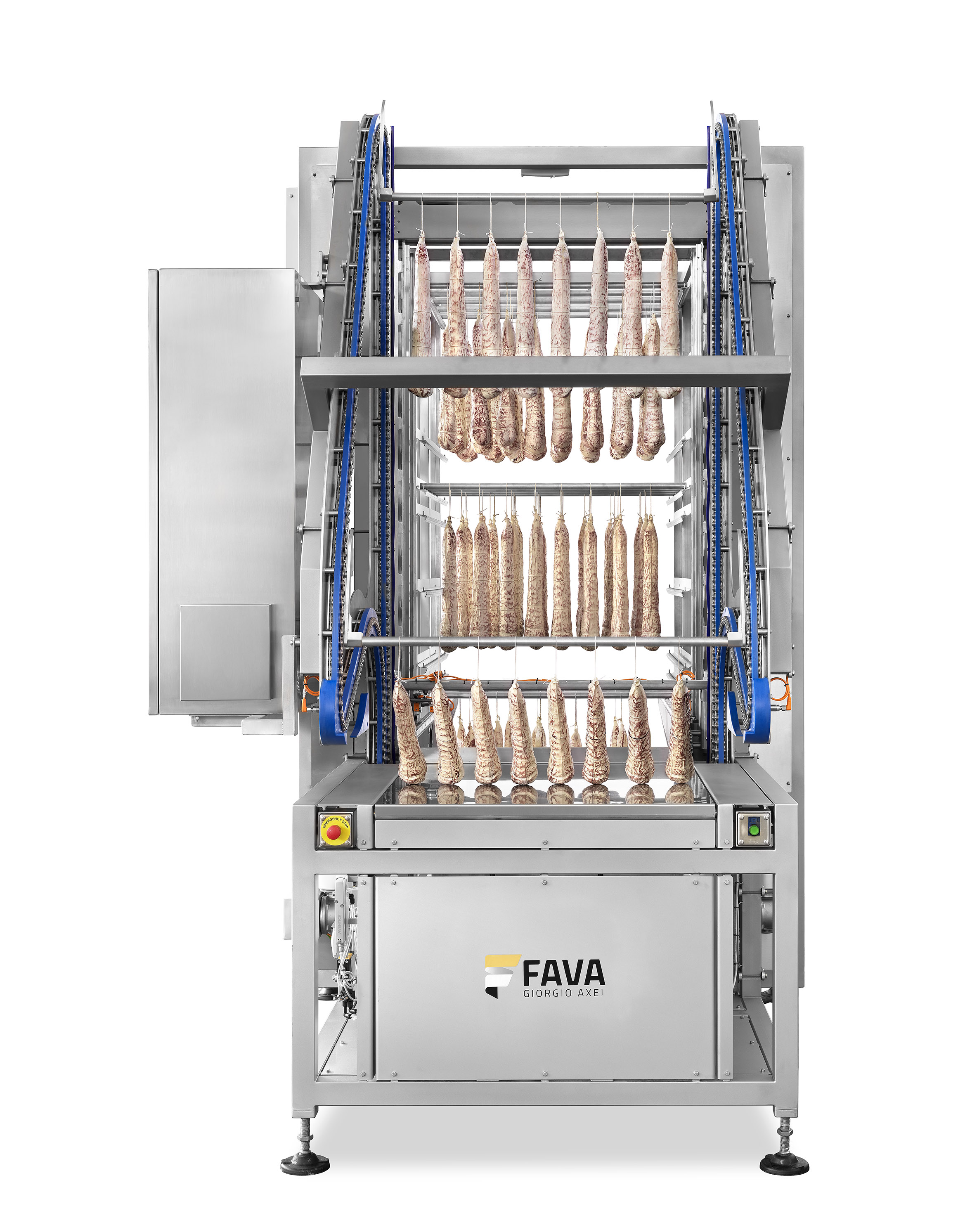
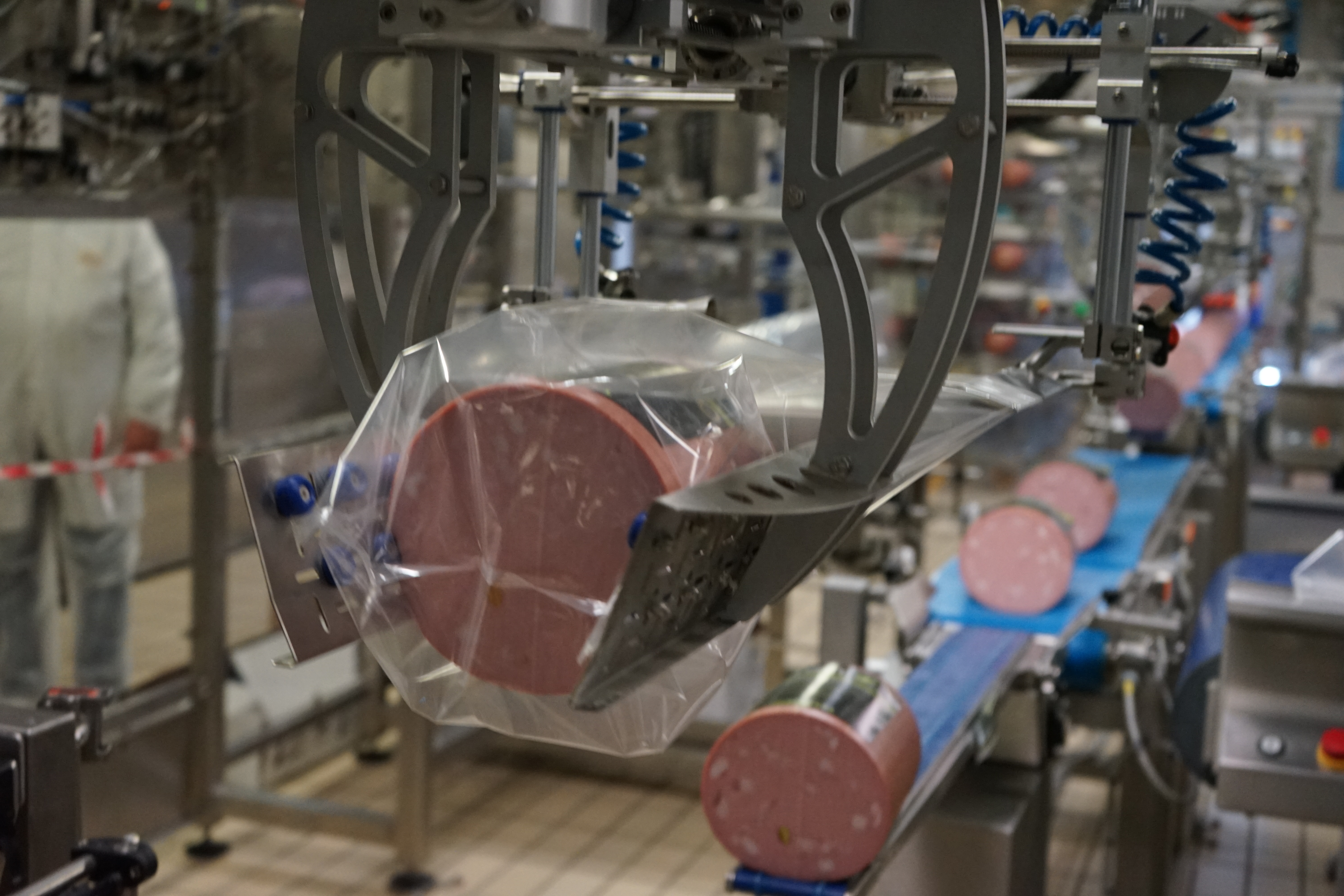
The TFRC system for loading and unloading hung deli meats, on trolleys, frames, trees or suspended conveyors, even of great height, can handle different products at the same time, coming from semi-automatic loaders, from automatic loaders, or taken from frames from production areas where manual loading is limited to the easiest level.
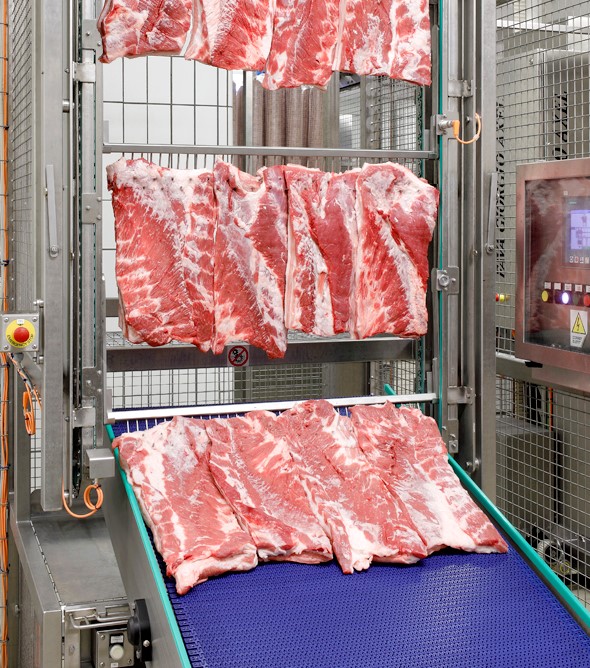
The same system is part of our system for the automatic hooking and unhooking of bellies for bacon.It is possible to pick up all the bars of an entire level; optimal acceleration management allows high speeds with very little oscillation of the products, with high throughput without products dropping.
It is able to handle frames of great height and handled by AGVs and of suspended tray conveyors. When unloading, it is also possible to transfer one pole at a time to the packing or peeling lines, even with automatic bar extraction or loop cutting.
The special design mode, protected by international patents,reduces the cross-sectional footprint of the system (only 300 mm more than the length of the frames to be loaded or unloaded); it is the most compact and easiest system to fit into existing production facilities.

The compact loaders and unloaders for frames, trolleys, trees or suspended conveyors on which to place bars with hanging products can be fed either by manual product placement stations on the bars, by automatic loading devices for salami or other products on bars. We also offer a version that can be used both as a loader and an unloader. The design, derived from our TFRC loading system, allows customizations depending on the length of the hanging bars (poles), the size of the frames (or trolleys or tees or suspended tray conveyors), and the size of the products. In the case of semiautomatic loading, the insertion of the hanging bars into the loops is manual as is the effortless positioning into the hooks of the lifting catenary for subsequent storage in the programmed level. It is also possible to feed the loader with automatic salamis hanging machines to the bars.

All models move the arms that deposit the bars with the hanging cold cuts vertically, to adapt to the frames, which, with the same width, can have different heights and lengths, just as the heights of the levels to be loaded can be different, also depending on the product.

The compact loader, like the unloader, makes it possible to proceed with the formation of levels even while replacing a full frame with an empty one, of course in total safety.

Bacon handling: combing and loading – unloading and decombing

The system for combing and loading bellies includes conveyor belts that feed the insertion units into the bars, a dynamic store from which the empty bars are taken, another for the bars with the product combed, and a TFRC Cartesian robot for frames or trees that transfers the empty bars into the dynamic store and picks up the bars with the bellies hung to load them into the frames, or trees, as soon as they are emptied. The system can process up to 8 bars/1′, with bellies from one or two feed lines, thus up to 40 bellies/1′ and the hooking device can load continuous systems.

The system for unloading and extracting the bars from the bellies includes a TFRC unloading unit that transfers the bars with hung, cooled or frozen product to a dynamic storage unit, and then picks up the empty bars and loads them orderly into the frames, or trees, to be transferred to the washing machine. The de-combing device extracts the bellies to transfer them to downstream processing stations; maximum throughput is 40 bellies/1′, also for the unloading of bellies from continuous systems.

Benefits

  • Reduced manpower in the combing, de-combing and washing areas
  • Reduction in management stress due to workers not showing up for work
  • Reduction in employee turnover
  • Reduction in strenuous and repetitive work
  • Reduction in occupational injuries and illnesses
  • Increased yields with better quality bacon
  • Improved yields through controlled mechanical combing and hanging
  • Elimination of overlapping and missed catching of CT muscle.

    Key features

    • RELIABILITY: systems developed on simple concepts, intrinsically strong and reliable
    • ADAPTABILITY: no need to replace suspended conveyors, cooking and smoking systems, cooling units, perhaps not even frames, racks and trees
    • COMPACTNESS: the least bulky on the market, it fits into most existing bacon processing plants
    • FLEXIBILITY: can work with products having different dimensional characteristics, even simultaneously
    • VERSATILITY: combing and extraction systems also suitable for continuous systems
    • SOLIDITY: the hooked bars and trees/frames are designed to avoid mechanical stress, eliminating the costly breakage and replacement expense of combs and trees, with obvious reduction of maintenance costs
    • SANITIZATION: easier washing and cleaning due to the improved design of hooked bars and trees
    • POWER: one unit can feed 6 slicing lines producing up to 3 different products at the same time
    • DESIGN: the system is specifically designed to also be used within existing bacon production units, can be easily adapted to production needs and expanded as the business grows.

More information about IFFA